Before you sign a roofing contract in Michigan, ask nine questions: Are you licensed with LARA? Can I see your insurance certificates? Who actually installs the roof? Is the warranty in writing? How many feet of ice and water shield? How do you fasten the underlayment and shingles? What is the ventilation plan? Do you require a deposit? Who pulls the permit? The answers, and how quickly they come, tell you almost everything.
I am Aaron Scott, licensed Michigan residential builder and owner of Roofing Army. I have sat across kitchen tables from hundreds of homeowners in Southeast Michigan, and the best ones ask hard questions. A roofer who does the work correctly welcomes them. This is the list I would use if I were hiring someone else to roof my own house in Oxford.
What Should You Ask a Roofer Before Signing?
Print this and bring it to every estimate. Write the answers down; you will be comparing them.
- Are you licensed in Michigan, and what is the license number? Michigan requires a residential builder license or a maintenance and alteration contractor license for residential work of $600 or more. Verify the number on the LARA license lookup. No number, no contract.
- Can you send me certificates of insurance for liability and workers compensation? Ask for certificates issued by the insurer with you listed as certificate holder. A photo of a card is not a certificate. Without workers compensation, an injury on your property can become your problem.
- Who will actually be on my roof: your employees or subcontractors? Many roofing companies sell the job and hand it to a subcontracted crew they have never met. Ask directly. Roofing Army uses in-house crews only, and a project manager is on site for every job.
- Is the workmanship warranty in writing, and what exactly does it cover? "Lifetime warranty" usually refers to the shingle manufacturer, not the installer. Ask for the workmanship warranty term, what it covers, whether it transfers to a buyer, and who honors it if the company closes. Ours is a 50-year workmanship warranty on every full replacement, in writing, registered in your job portal.
- How many feet of ice and water shield will you install, and where? The Michigan Residential Code requires an ice barrier at the eaves extending at least 24 inches inside the exterior wall line. A contractor should answer in feet, not with "code." We install 6 feet at every eave and full coverage on slopes under 4/12 pitch.
- How do you fasten the underlayment and the shingles? Underlayment should be fastened with cap nails, not staples, so wind cannot rip it before the shingles go on. Shingles should be nailed to the manufacturer's specification for your roof, with the correct count and placement, because that is what the shingle warranty depends on.
- What is your ventilation plan for my attic? A roofer who says "ridge vent" without looking at your soffits has not done the math. Ask what intake and exhaust you have now, whether they are balanced, and what changes are included. We do a ventilation analysis on every estimate.
- Do you require a deposit? A deposit is where most contractor disputes start. We have never taken one. If a contractor insists, ask why an established company needs your money before delivering materials.
- Who pulls the permit, and under whose license? Roof replacements in Southeast Michigan generally require a permit, and it should be pulled by the contractor under their license, not by you as a homeowner. Our permit guide covers what different cities charge.
Why Does "Who Installs the Roof" Matter So Much?
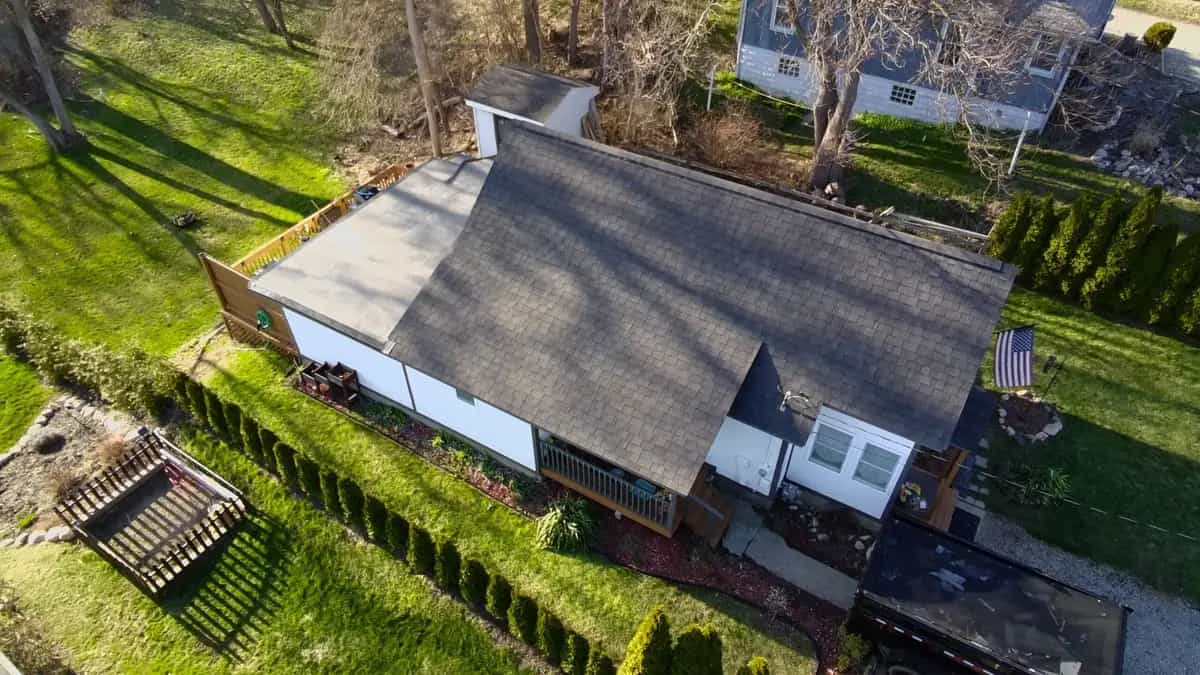
Because the crew is the roof. The shingle brand matters less than whether the person nailing it knows how many nails go in, where the nail line is, how to weave a valley, and how to flash a chimney. When the company that sold you the job is not the company installing it, quality control depends on a subcontractor's incentives, which are speed and volume. When something goes wrong a year later, the salesperson blames the crew and the crew is gone.
That is why we built our company around in-house crews and a project manager on every site. It costs more to run. It is also why the roofs in our job gallery look the same in year one and year ten.
What Should the Written Contract Include?
The answers to the questions above are only worth something if they are in the contract. A complete roofing contract in Michigan should spell out:
- Shingle manufacturer, product line, and color.
- Underlayment type and fastening method.
- Ice and water shield coverage in feet, and which slopes get full coverage.
- Starter strip and hip and ridge cap products.
- Flashing: which flashings are replaced versus reused, and the metal type.
- Ventilation: what is added, removed, or covered, and why.
- Pipe boots and vents: replaced, not reused.
- Decking: the price per sheet for rotted decking replacement, and that you will be shown the rot before it is replaced.
- Tear-off and disposal, including how the yard and landscaping are protected and how nails are cleaned up.
- Permit responsibility.
- Payment terms, with no deposit, and a total price with line items.
- Workmanship warranty term and manufacturer warranty registration.
If a contractor's proposal is a single line reading "tear off and replace roof, $14,500," you have no way to compare it against anyone else's. Ask for the line items.
How Do You Compare Roofing Quotes Fairly?
Most homeowners get three quotes and compare the totals. That only works if the three roofs are the same roof, and they rarely are. One includes 6 feet of ice and water shield and new flashing; another includes 2 feet and reuses the flashing. The cheaper quote is not cheaper; it is a different product.
Two things fix this. First, ask every contractor the same nine questions and write down the answers next to the price. Second, compare against real numbers. We publish the price of every roof we install. A full replacement at 4586 Lehigh Drive in Troy was $15,118 for 2,202 square feet. 3537 Mildred Avenue in Rochester Hills was $14,469 for 1,720 square feet. 26 West Street in Oxford was $11,904.27 for 1,440 square feet. Each of those is in the job gallery with the full spec, so you can see what the money bought.
We also give every homeowner five quotes at different price points, from a solid basic system to a premium one, with the same installation standards on all five. The difference is the shingle and the accessories, not whether the underlayment is stapled.
What Answers Should End the Conversation?
Some answers are disqualifying on their own:
- "We don't really need a permit for this."
- "We're fully insured" with no certificate to follow.
- "We need half down to order materials."
- "Code minimum" as the answer to the ice and water shield question.
- "We use our own guys" that turn out to be a different company's truck on install day.
- Any pressure to sign before you have finished asking questions.
If you are trying to decide whether the roof needs replacing at all, read our repair-or-replace framework first. If it does, our roof replacement page explains exactly how we build a roof, and the inspection that starts the process is free. Bring the questions. We like them.
Frequently Asked Questions
How many quotes should I get for a roof replacement?
Two or three from licensed local companies is usually enough, provided you ask each the same questions and compare line items rather than totals. A quote with 6 feet of ice and water shield, new flashing, and cap-nailed underlayment is not the same product as one with the code minimum and reused flashing, even if the totals are close.
Should a roofer require a deposit in Michigan?
An established roofing company does not need your money before the work starts. Roofing Army has never taken a deposit on any job. If a contractor insists on one, ask what it is for and consider it a warning sign, particularly after a storm.
What is the difference between a workmanship warranty and a manufacturer warranty?
The manufacturer warranty covers defects in the shingles themselves and is issued by the shingle maker. The workmanship warranty covers installation errors and is issued by the roofing company. Most roof failures are installation failures, so the workmanship warranty term, and whether the company will still exist to honor it, matters more than the word lifetime on a shingle wrapper.
How much ice and water shield should a Michigan roof have?
The Michigan Residential Code requires an ice barrier at the eaves extending at least 24 inches inside the exterior wall line. Our standard is 6 feet from the eave edge on every roof, plus full coverage on any slope under 4/12 pitch, because low-pitch Michigan roofs hold snow and ice dams push water far beyond the code minimum.
Why does the ventilation plan matter on a roofing quote?
Poor attic ventilation cooks shingles from below in summer and creates ice dams in winter, and shingle manufacturers can deny warranty claims on inadequately ventilated roofs. A roofer who has not measured your intake and exhaust cannot tell you whether your new roof will last. Ask for the analysis, not just a ridge vent line item.