Roof Pitch Calculator
Turn a rise and run into pitch, degrees, slope and the multiplier estimators use.
Roof pitch
6/12
average, walkable
Multiply your home's footprint by the pitch multiplier to estimate roof area. Anything at 7/12 or steeper costs more to roof: harnesses, roof jacks and slower production. Below 2/12, shingles are not an option and the roof needs a low-slope membrane.
Roof pitch is the rise in inches for every 12 inches of horizontal run, written as a ratio like 6/12. A 6/12 roof rises 6 inches per foot, sits at 26.6 degrees, has a 50% slope, and carries a pitch multiplier of 1.118, meaning the roof surface is 11.8% larger than its footprint. The calculator above converts rise and run (or degrees) into all four figures. I am Aaron Scott, a licensed Michigan residential builder and the owner of Roofing Army, and this guide covers what pitch changes on a roof and how to measure yours from the attic in five minutes.
What does the roof pitch calculator estimate?
Enter the rise and run in inches, or enter the angle in degrees, and the calculator returns the pitch as x/12, the angle in degrees, the slope as a percentage, and the pitch multiplier. The multiplier is the useful one: multiply your roof footprint by it and you have the true surface area, which is what every shingle order and every quote is built on. Our roofing materials calculator takes that area the rest of the way to squares and bundles.
How does the calculator get its numbers?
It is trigonometry, nothing more. Pitch is rise divided by run, scaled to a 12 inch run. Degrees is the arctangent of rise over run. Slope percent is rise over run times 100. The multiplier is the square root of 1 plus the square of rise over run, which is the length of the sloped side of the triangle when the flat side is 1. Here are the common Southeast Michigan pitches:
| Pitch | Degrees | Slope | Multiplier | Typical house |
|---|---|---|---|---|
| 3/12 | 14.0 | 25% | 1.031 | Porch roofs, additions, some 1950s ranches |
| 4/12 | 18.4 | 33% | 1.054 | Postwar ranches in Berkley, Oak Park, Madison Heights |
| 6/12 | 26.6 | 50% | 1.118 | Most 1970s to 1990s colonials and split-levels |
| 8/12 | 33.7 | 67% | 1.202 | Newer colonials in Rochester Hills, Macomb, Shelby Township |
| 10/12 | 39.8 | 83% | 1.302 | Steep colonials, Tudors, some Bloomfield estates |
| 12/12 | 45.0 | 100% | 1.414 | A-frames, Cape Cod dormers, chalet styles |
How does pitch change the price of a roof?
Three ways, and they stack. First, area: the same footprint is 5% bigger at 4/12 and 30% bigger at 10/12, so a steep roof needs more of everything. Second, labor: past about 6/12, crews cannot stand and walk the roof without toe boards and harness lines, and everything from carrying bundles to snapping lines slows down. Above 8/12 the roof becomes staged work, with roof jacks and planks moved up the slope as the shingles go on. Third, safety equipment and time: OSHA classifies any roof steeper than 4/12 as a steep roof for fall protection, and the harnesses, anchors, and ladder setups that requires all take hours that show up on the quote.
Our published prices show it. We divide every job's price by its roof area, and half of our published asphalt roofs landed between $5.99 and $7.07 per square foot. The roofs that priced well above that band were mostly steep or cut-up. Our Shelby Township replacement on Judy Lane came in at $22,746.56 for 2,274 square feet, $10.00 per square foot, while our Rochester roof on Longford Drive was 3,030 square feet at $18,440.16, or $6.09. The smaller roof cost more. Pitch and complexity are the difference, and you can compare every project in our job gallery.
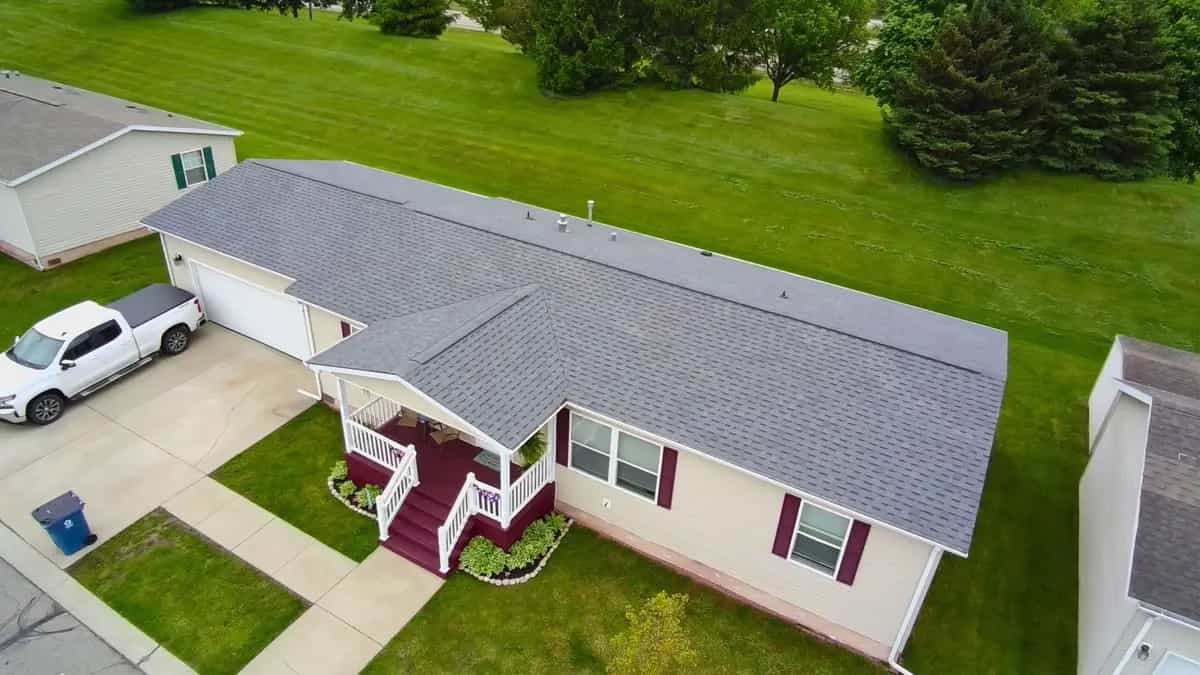
How does pitch change safety and materials?
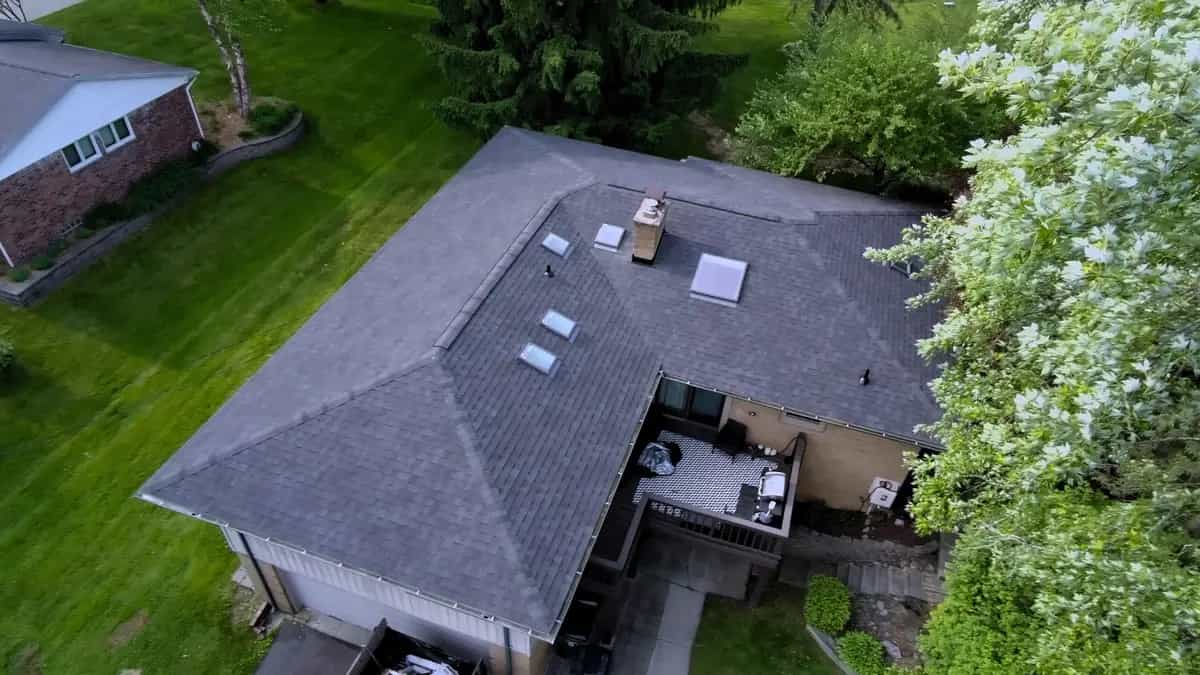
On the low end, water is the problem. Below 4/12, water moves slowly enough that wind can push it back up under shingle laps and ice dams form easily, so we install full ice and water shield over the entire slope rather than just the eaves. Below 2/12, asphalt shingles are not a proper roof covering at all; those sections get a low-slope membrane. Shallow porch roofs and additions on ranches in Royal Oak and Ferndale are where we see this most.
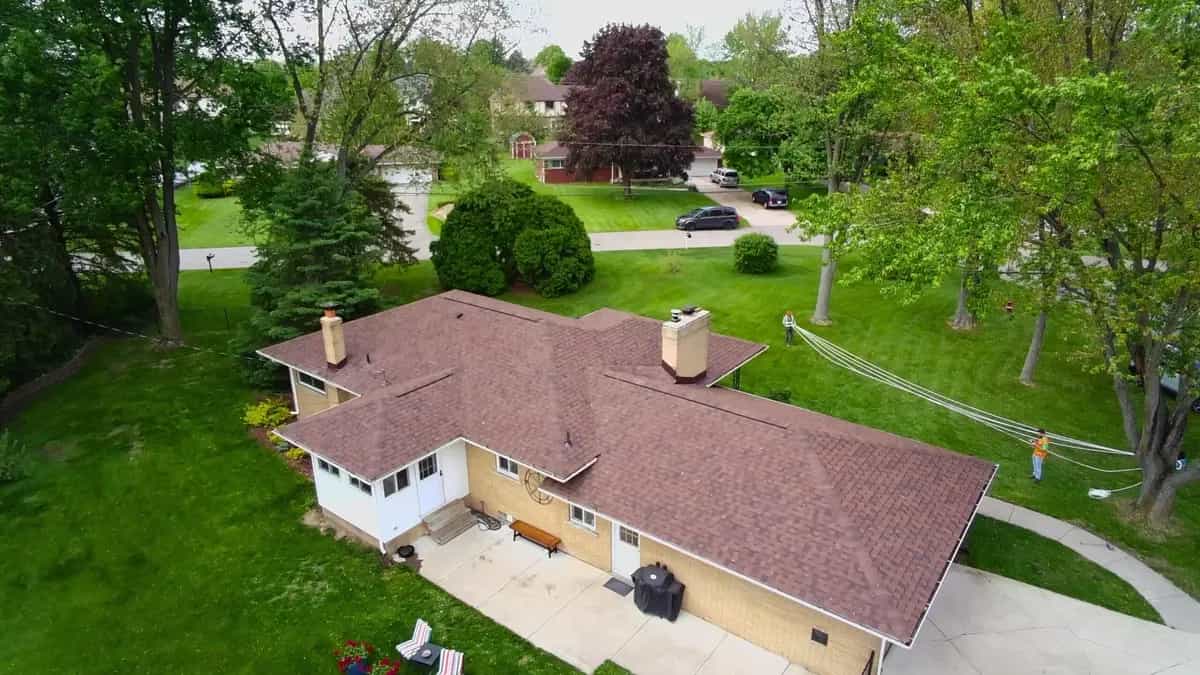
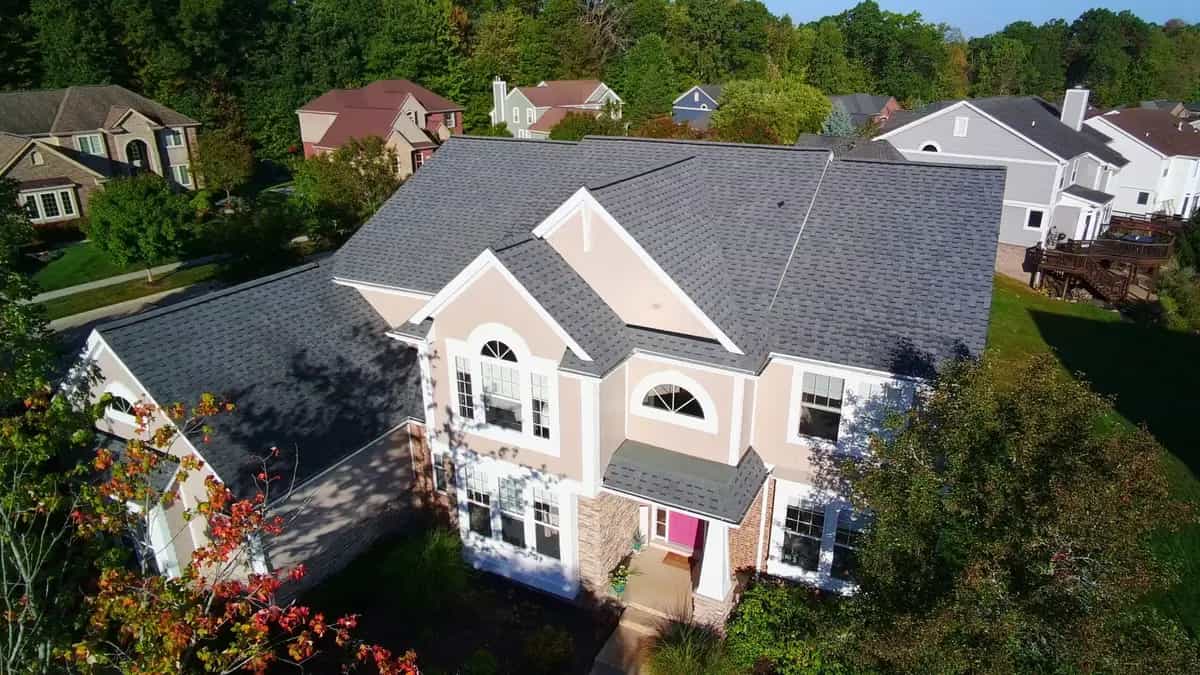
On the high end, the roof sheds water beautifully and the risk shifts to the people on it. Steep colonials in Rochester Hills and Macomb Township get harness anchors, roof jacks, and slower, staged work. Shingle manufacturers also change the nailing pattern on very steep slopes and in high-wind areas, and hand-sealing may be required where the sun cannot warm the adhesive strip. A project manager is on site on every job to make sure the crew is set up for the pitch they are on, not the one from yesterday's roof.
How do you measure roof pitch from the attic?
You do not need to get on the roof. From inside the attic:
- Find a rafter or truss top chord you can reach, and hold a level flat against its underside with the bubble centered.
- Mark 12 inches along the level from where it touches the rafter.
- Measure straight up from that 12 inch mark to the underside of the rafter. That vertical distance in inches is your rise per foot.
- Enter rise and 12 in the calculator above. If you measured 6 inches, the roof is 6/12.
From outside, you can hold the level against the roof edge at a gable end and do the same measurement, or use a smartphone level app on the roof surface and enter the degrees. If your attic has no access, the pitch can be read from the gable end from the ground with a speed square at arm's length, though the attic method is more accurate. While you are in the attic, look at the insulation depth and check for daylight at the eaves, which tells you whether baffles and intake vents are doing their job. Our attic ventilation service starts with that same look.
What can the calculator not see?
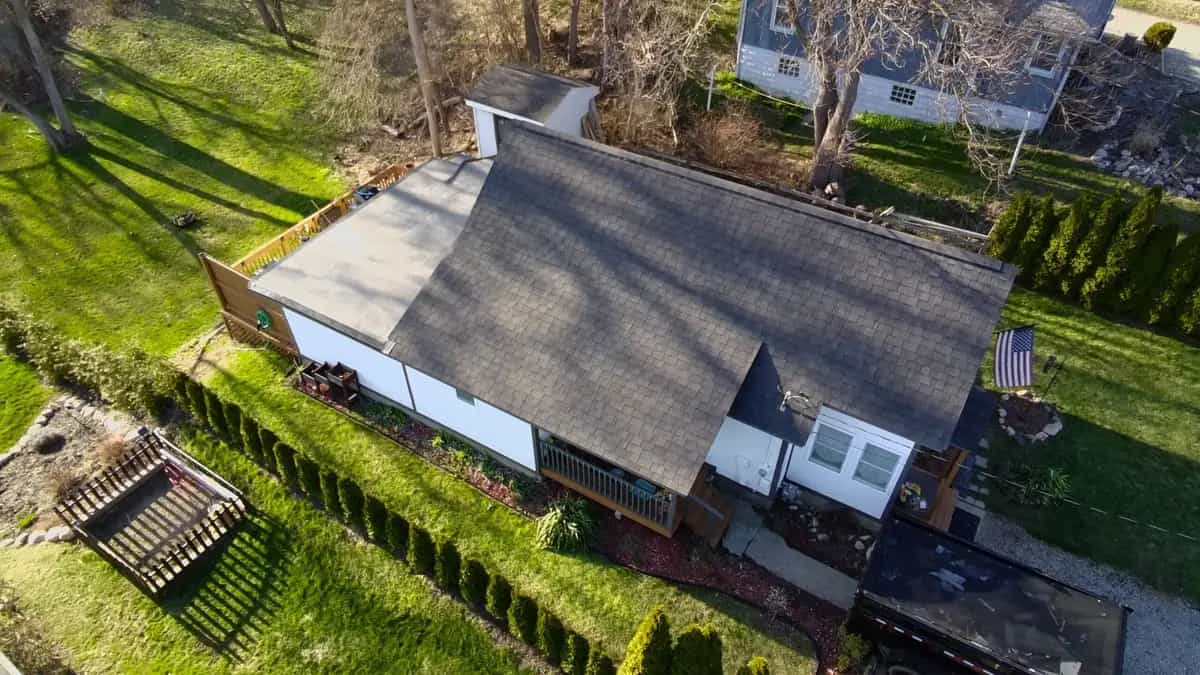
A roof with more than one pitch, which is most colonials with a porch or garage. Measure each section and run them separately. It also cannot see the complexity that comes with pitch: a steep roof with two valleys and a dormer prices very differently from a steep gable of the same area, which is why footprint and pitch get you a range and an inspection gets you a number. If your roof is steep enough that you are wondering whether a repair is safe to attempt yourself, the answer is no; our roof repair crews are set up for it. And for the price side of the question, our Michigan roof cost guide and city guides like Rochester Hills give real ranges from real jobs. See how we build a roof on our roof replacement page.
Frequently Asked Questions
What is the most common roof pitch in Michigan?
Postwar ranches across inner-ring suburbs like Berkley, Oak Park, and Madison Heights are commonly 4/12, while colonials and split-levels built from the 1970s on are most often 6/12 to 8/12. Newer subdivisions in Rochester Hills, Macomb, and Shelby Township trend toward 8/12 and steeper.
What is a roof pitch multiplier and why does it matter?
The multiplier converts a roof's flat footprint into its true sloped surface area. It equals the square root of 1 plus the square of rise over run: 1.054 at 4/12, 1.118 at 6/12, 1.202 at 8/12, 1.414 at 12/12. Multiply footprint by the multiplier to get the area every shingle order and quote is based on.
Does a steeper roof cost more to replace?
Yes. A steeper roof has more surface area for the same footprint, requires harnesses, anchors, and roof jacks, and slows the crew down. On our published jobs, the roofs priced above our typical $5.99 to $7.07 per square foot band were mostly steep or cut-up, including a 2,274 square foot Shelby Township roof that cost $10.00 per square foot.
What is the minimum pitch for asphalt shingles?
Asphalt shingles are not a proper roof covering below 2/12. Between 2/12 and 4/12 they need extra underlayment protection; on our jobs any slope under 4/12 gets full ice and water shield coverage. Sections below 2/12, such as some porch and addition roofs, get a low-slope membrane instead.
How do I convert roof pitch to degrees?
Take the arctangent of rise divided by run. A 4/12 roof is 18.4 degrees, 6/12 is 26.6 degrees, 8/12 is 33.7 degrees, 10/12 is 39.8 degrees, and 12/12 is 45 degrees. The calculator above converts in either direction, so you can enter degrees from a phone level app and get the x/12 pitch.