Roofing Materials Calculator
Squares, bundles, underlayment and nails for a roof, from the footprint and pitch.
Shingles to order
68 bundles
22.6 squares including waste
A square is 100 square feet of roof. Bundles per square depend on the shingle line, so check the wrapper. Starter strip, hip and ridge cap, ice and water shield, drip edge and vents are ordered separately. We measure every roof from a satellite report and confirm it on site before ordering.
A roofing square is 100 square feet of roof surface, and everything on a shingle order is counted in squares. To get there you need the roof footprint, the pitch to convert footprint to true surface area, a waste percentage for the cuts, and the number of bundles per square for your shingle. The calculator above does that conversion and returns roof area, squares, bundles, synthetic underlayment rolls, and pounds of nails. I am Aaron Scott, a licensed Michigan residential builder and the owner of Roofing Army, and here is how we get from a tape measure to a material order.
What does the roofing materials calculator estimate?
Enter the footprint of the roof in square feet (the area it covers from above, including overhangs), the pitch, a waste percentage, and the bundles per square for your shingle. The calculator returns the true roof area, the number of squares including waste, the shingle bundles to order, the rolls of synthetic underlayment at 10 squares per roll, and an estimate of the nails in pounds. It is a material takeoff, not a price; for what a finished roof costs, our Michigan roof replacement cost guide uses our real invoices.
How does the calculator get its numbers?
Footprint times the pitch multiplier gives the surface area. The multiplier is the square root of 1 plus the square of rise over run; a 6/12 roof has a multiplier of 1.118, so a 1,800 square foot footprint has about 2,012 square feet of roof. Our roof pitch calculator gives the multiplier for any slope.
Add the waste percentage, divide by 100, and round up to whole squares. Multiply squares by bundles per square for the shingle count. Most architectural shingles, including the Atlas lines we install most often, run 3 bundles per square; heavier designer shingles can run 4 or 5. Synthetic underlayment is sold in rolls that cover 10 squares, so rolls are squares divided by 10, rounded up. Nails follow the manufacturer's pattern of four nails per shingle, six in high-wind nailing; the calculator converts the count to pounds using standard 1 1/4 inch coil roofing nails, which works out to roughly 2 pounds per square.
Worked example: a Southeast Michigan colonial
A 1,800 square foot footprint at 6/12 with 10% waste and 3 bundles per square:
| Line | Math | Result |
|---|---|---|
| Roof area | 1,800 x 1.118 | 2,012 sq ft |
| With 10% waste | 2,012 x 1.10 | 2,214 sq ft |
| Squares | 2,214 / 100, rounded up | 23 squares |
| Shingle bundles | 23 x 3 | 69 bundles |
| Synthetic underlayment | 23 / 10, rounded up | 3 rolls |
Change the waste to 15% for a cut-up roof and the order becomes 24 squares and 72 bundles. Real roofs check out against this. Our Oxford replacement on South Glaspie Street was 2,480 square feet of roof, about 25 squares, and our Lake Orion project on Hi Crest Drive was 2,646 square feet, roughly 27 squares. Every project in our job gallery lists its roof area, so you can find a house like yours and see the squares alongside the price.
How much waste should you add?
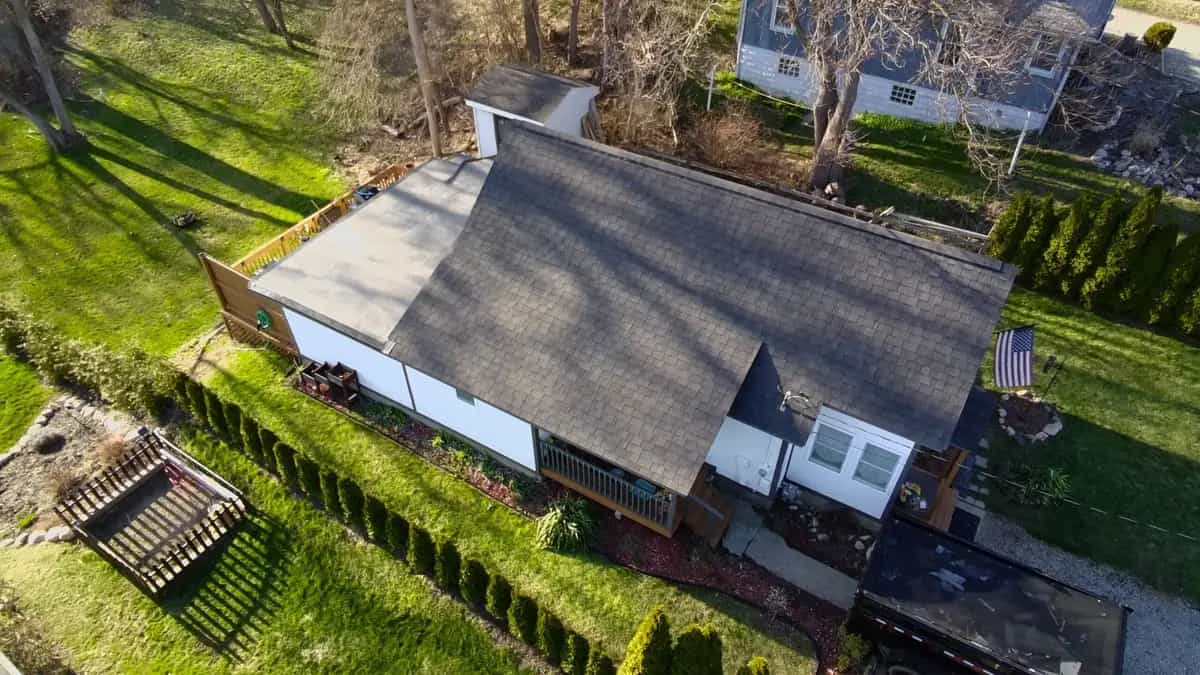
Waste is the shingle material that ends up in the dumpster: cuts at rakes, hips, valleys, and around penetrations, plus the starter and cap you cut from full shingles if you are not using dedicated products. The right percentage depends on the shape of the roof:
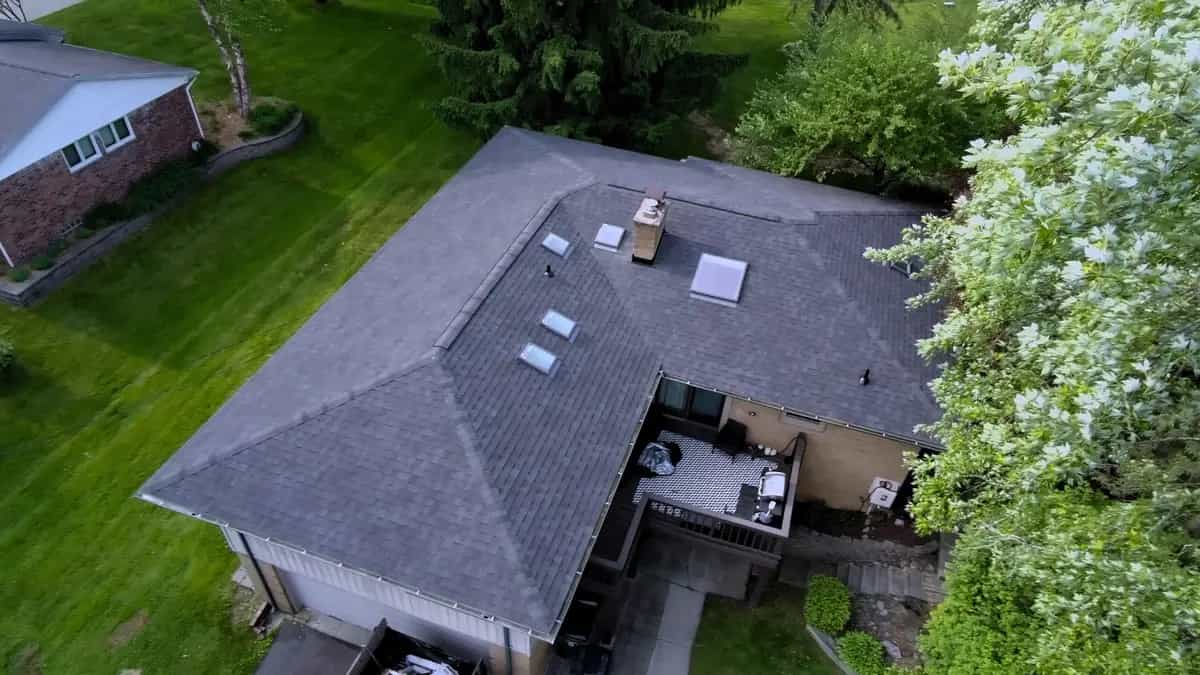
- Simple gable, two slopes, few penetrations: 5% to 10%. A postwar ranch in Madison Heights or Oak Park usually sits here.
- Hips, a few valleys, dormers: 10% to 15%. Most Southeast Michigan colonials.
- Cut-up roof with many valleys, hips, and turrets: 15% to 20% or more. Every valley cut wastes a triangle on each side.
Two reasons we always order on the high side. Running short mid-job means a supply run while a crew stands on the roof, and a second delivery of shingles can come from a different production lot with a slightly different color. Unopened bundles can usually be returned to the supplier, so over-ordering by a bundle costs little; under-ordering costs a day.
Why do we fasten underlayment with cap nails instead of staples?
Synthetic underlayment is the last line of defense between a wind-lifted shingle and bare plywood, and how it is fastened decides whether it stays put. A staple has two thin legs and a narrow crown that cuts through synthetic sheet under wind load; a lifted corner then tears along the staple line. A cap nail has a plastic cap about an inch across that spreads the hold over the sheet, and manufacturers of synthetic underlayment specify cap nails or cap staples for that reason. We use cap nails on every roof, spaced per the manufacturer's pattern, with tighter spacing at laps and edges. Staples are faster. They are also how a roof that looked fine in October ends up with underlayment flapping in a March windstorm before the shingles are even a season old.
What is not on this list?
A shingle order is only part of a roof. The calculator does not count:
- Ice and water shield at eaves, valleys, and penetrations. We run 6 feet at every eave; our ice and water shield calculator sizes it.
- Starter strip and hip and ridge cap, which we always install as dedicated products rather than cut-down shingles.
- Drip edge, pipe boots, step and counter flashing, and vents. Every vent stack gets a new boot on our jobs.
- Ventilation components. Ridge vent, can vents, baffles, or a solar fan, depending on what the ventilation analysis calls for. See our attic ventilation service.
- Decking. Nobody knows the plywood count until tear-off. We quote a per-sheet price in writing before the job starts.
What can the calculator not see?
Footprint from a listing or a tax record often excludes overhangs and the garage, which can add 10% to 20% to the real roof area, so measure the roof, not the house. A roof with two different pitches (a shallow porch on a steep main house) needs two calculations added together. And the single biggest thing it cannot see is the deck itself: rot, delamination, and old plank spacing all change the order once the shingles are off. We replace roofs across Southeast Michigan, including Oxford, Sterling Heights, and Canton, and a project manager measures every roof in person before an order is placed. Learn how we build the whole system on our roof replacement page.
Frequently Asked Questions
How many bundles of shingles are in a square?
Most architectural asphalt shingles are packaged 3 bundles per square, where a square is 100 square feet of roof surface. Heavier designer and premium shingles can be 4 or 5 bundles per square. Check the bundle count on the specific product line, then multiply by the number of squares including waste.
How do I calculate how many squares my roof is?
Multiply the roof footprint by the pitch multiplier to get true surface area, add a waste percentage, and divide by 100. A 1,800 square foot footprint at 6/12 pitch is about 2,012 square feet of roof, or 22.1 squares before waste and 23 squares after 10% waste.
How much waste should I add to a shingle order?
Use 5% to 10% for a simple gable roof, 10% to 15% for a roof with hips, valleys, or dormers, and 15% to 20% or more for a heavily cut-up roof. Order on the high side; unopened bundles can usually be returned to the supplier, but a mid-job shortage stops the crew and can mean a color-lot mismatch.
How many rolls of synthetic underlayment do I need?
Standard synthetic underlayment rolls cover 10 squares. Divide your squares by 10 and round up, so a 23 square roof needs 3 rolls. Fasten it with cap nails, not staples; staples cut through synthetic sheet under wind load and are the most common reason underlayment tears off before the shingles are even installed.
How many nails does a roofing square take?
Manufacturers specify four nails per shingle for standard installations and six in high-wind nailing zones. At four nails per shingle on a 3 bundle per square product, the count works out to roughly 2 pounds of 1 1/4 inch coil roofing nails per square, more with six-nail patterns. The calculator above converts your squares to pounds.